
On another page the system of coloured belts we use is described. There is a risk that sometimes the status that one might feel from being entitled to wear a particular colour belt gains undue precedence. It is important to keep in mind that the colour system is only a marker system on the journey towards proficiency. Achieving the rank of black belt is a reasonable goal to have. It is likely that if it remains the only goal then the student will fail to achieve it.
Achieving the first black belt grade of Shodan is a recognition that the student has reached an acceptable proficiency in the basics. It is noteworthy that we have no other external marker of progress beyond this point on our belts other than perhaps fraying from use.
We belong to a club, the Dunedin Institute of Traditional Karate. Clubs train in a space called a dojo. In New Zealand it is unusual for clubs to have purpose built dojos. Commonly we used buildings or halls that serve many other purposes.
The purpose of training is to improve your individual knowledge and ability with the multiple components of this particular martial art. That purpose is achieved by constant repetition. Rarely will techniques be close to correct from the start. Teachers will correct deviations from ideal and if the student wishes to improve they will note that teaching and strive to implement it. Even very senior black belt students have their techniques corrected by their teachers. In this way the student should gradually improve over time.
However, training is not a race to the next belt or grading and it does not represent competition with anybody other than oneself.
Within New Zealand not all dojos are organised the same way and the patterns followed differ widely. What follows is what we do. They are not ‘better’ than anybody else’s system, they are just what we do.
When we use the church hall for our training, when the image below are on the wall (Shomen) it is considered to be our dojo.
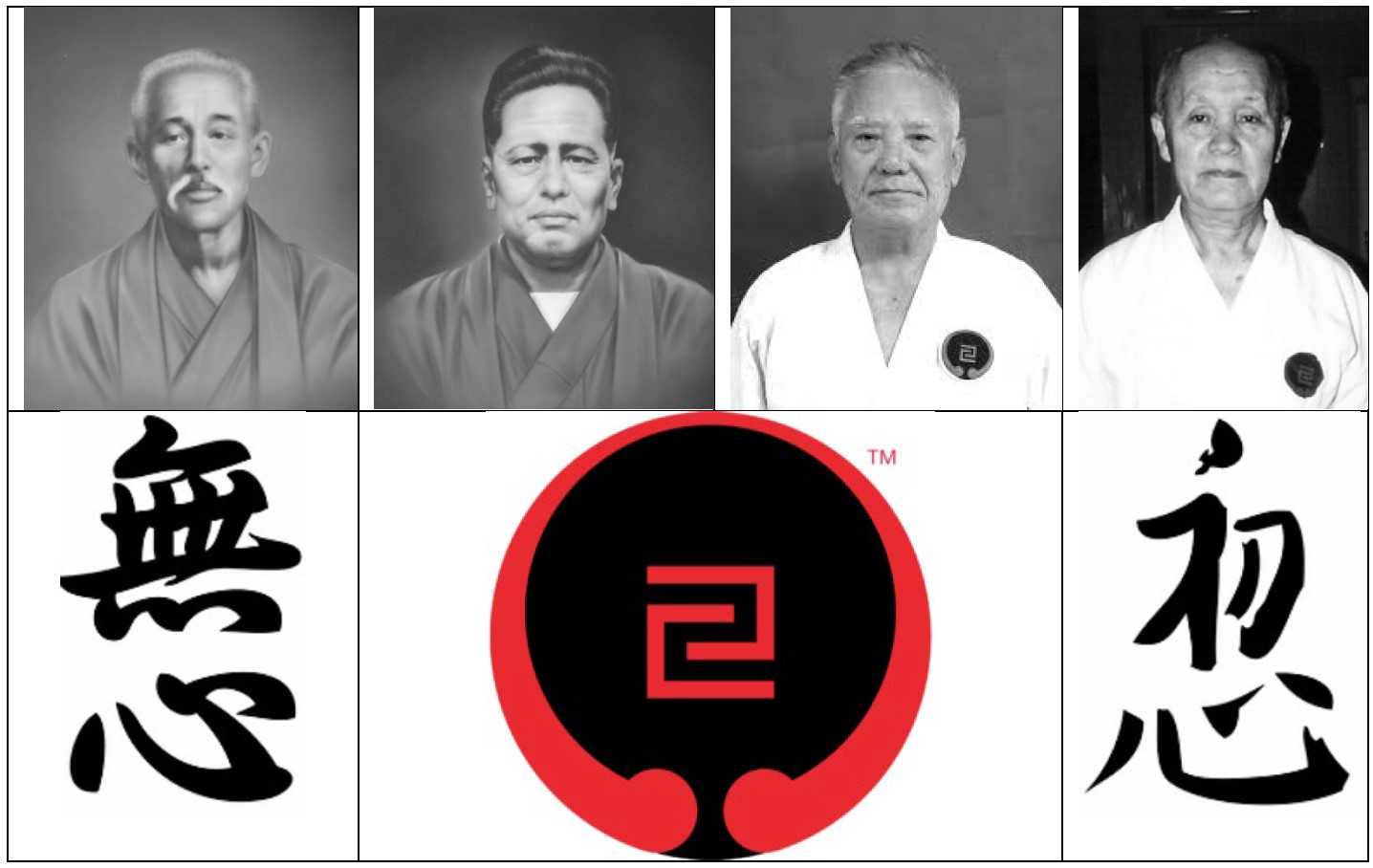
The four images across the top represent the lineage of our style of karate and are from left to right;
- Kanryo Higaonna Sensei 1853-1915
- Chojun Miyagi Sensei 1888-1953
- An’ichi Miyagi Sensei 1931-2009
- Shuichi Aragaki Sensei 1929-2021
Following study in China, Kanryo Higaonna Sensei, returned to Okinawa and created a style of karate he called Naha-te. He was the teacher of Chojun Miyagi Sensei who developed a style of karate which he called Goju Ryu, the general style we practice today. One of his students, An’ichi Miyagi Sensei, was the teacher of Morio Higaonna Sensei who founded our particular branch of Goju Ryu.
Shuichi Aragaki Sensei was also a student of Chojun Miyagi Sensei, was the first teacher of Tetsuji Nakamura Sensei, our world chief instructor.
The grandfather of Shuichi Aragaki Sensei, Ryoko Aragaki Sensei, was Chojun Miyagi’s first teacher. He introduced Chojun Miyagi to Kanryo Higaonna Sensei who then became his main teacher.
A more detailed outline is available at https://iogkf.com/goju-ryu-history/
The image in the middle of the bottom row of the logo of our style. A detailed explanation of the symbols is available at https://iogkf.com/about-iogkf/iogkf-logo/
The Japanese kanji symbols at the left and right of the bottom row represent two of the Five Spirits of Budo.
The image on the right represents Shoshin
Shoshin: (初⼼) Beginners Mind, Spirit of Beginner
The state of shoshin is the beginner’s state of mind. It is the state of attention of one who remains fully aware, attentive and ready to see everything as if it were the first time, despite however many years of training one has pursued. The shoshin attitude is essential for constant learning.
It is very common to miss the opportunity for learning by making an assumption one already knows something.
The image on the left represents Mushin
Mushin: (無⼼) Empty Mind, No-Mind.
Mushin is a state where one is acting but not having to think about how to do those actions. Something you do automatically, like walking, running, driving a car. It is a state of mind without fear, anger, or anxiety.
Achieving Mushin is at the core of our karate training.
Take your shoes off before entering and bow at the door. You should use your time before the formal class begins by warming up, stretching and practicing your techniques. This is an ideal time to ask more senior students for help. This is not time for play. We expect that senior students, especially the green and brown belts will start to answer more junior (Kohai) student’s questions. It is important that questions are answered within their secure knowledge base. Any doubt must always be deferred to a more senior person. We encourage questions, and teaching is an excellent way of learning.
A short lecture on dojo etiquette given by Shihan Morio Higaonna can be seen here.
When Sensei Marrable arrives somebody, usually the most senior student present, will call out “kiotsuke”. You should immediately stop what you are doing, turn to face sensei and bow. You will hear the more senior students say onegaishimasu” {on-ee-guy-shi-mass} which means “please teach me” or “please show me”. He will return your bow and then you should return to what you were doing.
At 6pm Sensei will call “Shugo”. This means stop whatever you are doing and quickly (do not run, but walk more quickly than normal) line up facing the front of the dojo. The front row will always have an even number (usually eight) of students starting on the far right with the most senior IOGKF black belt. Once the IOGKF black belts are in place the non-IOGKF black belts take their place and then all the coloured belts following in descending grade. It is the responsibility of the students to ensure they are always in a row behind somebody in the front row and are in line with the person to their immediate right.
There should be no talking and no looking around. Attention should be focussed on Shomen. The senior student will call out “Seiza” (which is when we all kneel down) and then call out “Mokuso” (close your eyes) followed a variable period of time later by “Mokuso yame” (open your eyes).
The purpose of this activity is to signal a break between the world outside the dojo and the formal training within. You should breathe in through your nose, and out through your mouth and try to put aside all the worries and thoughts of what happened at school or work, or what issues you are going to have to deal with when you leave. You are entering formal training and your complete attention should be in the dojo. We hold no spiritual, religious or any other connotation to this ceremony.
We then bow to the front of the dojo and then to sensei. The closing ceremony is similar to the opening ceremony. The biggest difference is that after we open our eyes a student will recite each line of the dojo kun (or rules) which all the students then repeat. The lines are;
Hitotsu Respect others
Hitotsu Be courageous
Hitotsu Train your mind and body
Hitotsu Practice daily and protect traditional karate-do
Hitotsu Strive to reach the essence of Goju-Ryu
Hitotsu Never give up
Hitotsu is a counter like ‘first’. We are indicating that each line is first, or of equal importance with the other rules.